French Leaseback: Renewal of the lease

French Leaseback Renewal of the lease traesch lawyer

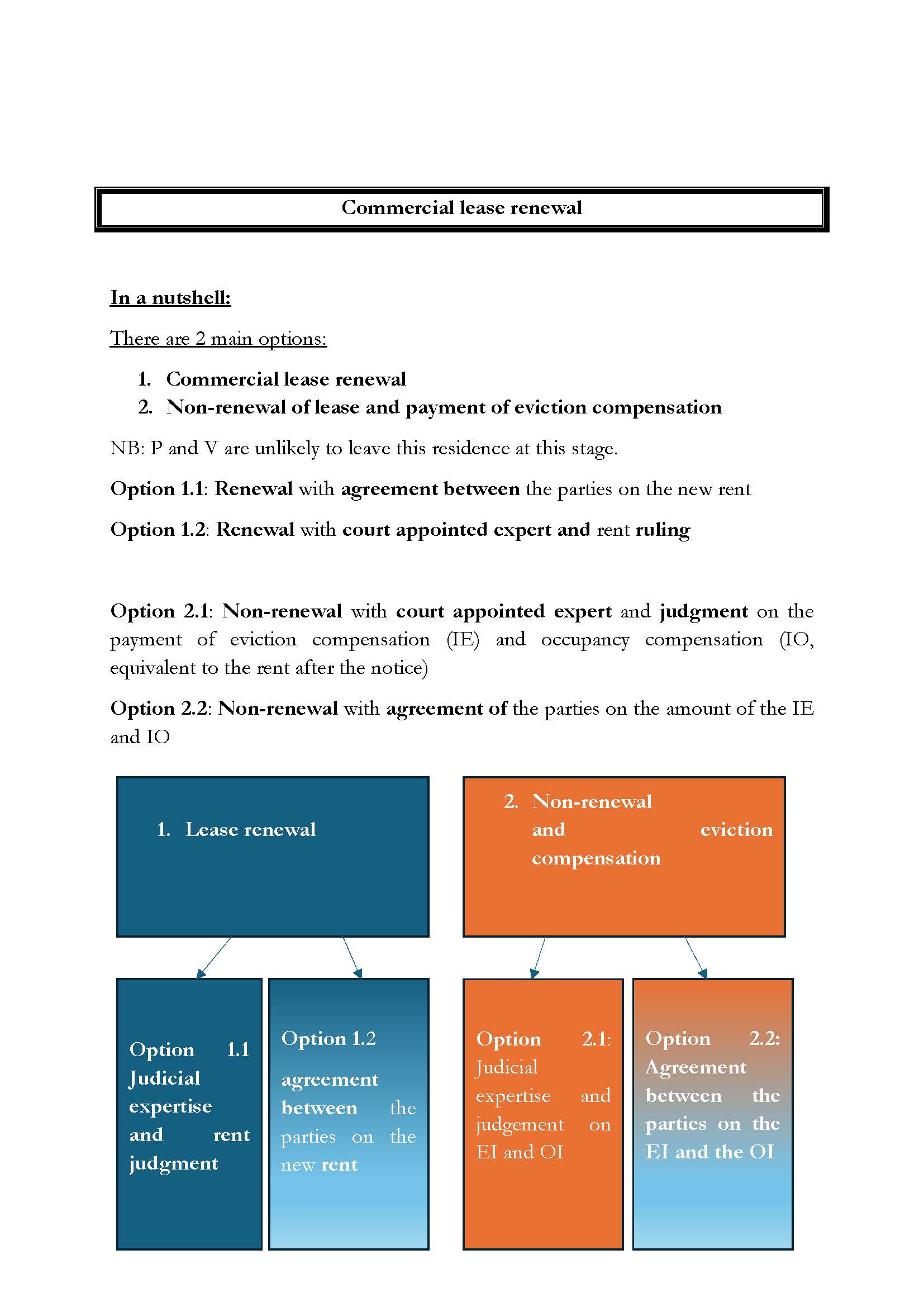
When it comes to commercial leases for tourist residences, the situation at the time of renewal of the lease at the end of the first nine years is of strategic importance to the lessor. Tourist residences are generally governed by standard commercial leases, with special features relating to tourist operations.
Here is an overview of the various options available to the lessor at the time of renewal:


1. Renewal of a commercial lease

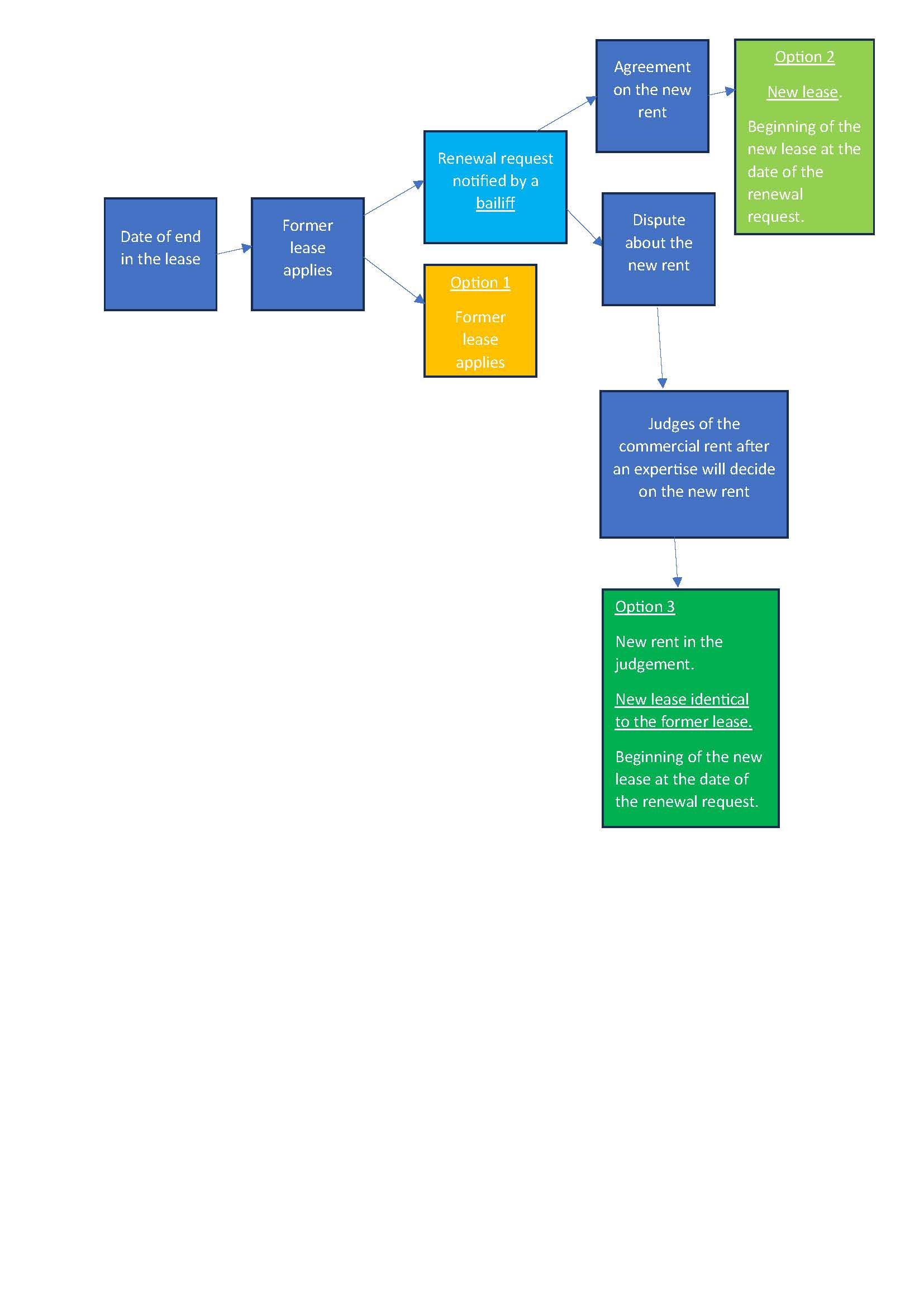
The default commercial lease is for nine years, but it can be renewed under certain conditions. The lessor is obliged to offer a renewal under the conditions set out in the Commercial Leases Act (articles L. 145-1 et seq. of the French Commercial Code). To this end, he must notify the tenant of an offer to renew six months before the end of the lease, or failing that, respond to the tenant’s request for renewal. Renewal is not automatic, but is in principle a right of the tenant, unless the lessor can give a legitimate reason for refusing.a. Renewed rentThe rent for a renewed lease must be set on the basis of the rental value, subject to a ceiling that may be exceeded in certain circumstances, in particular in the event of a significant change in local market factors or in the event of a contractual de-capping clause in the lease.

2. Refusal to renew with eviction compensation

If the lessor does not wish to renew the lease, he may refuse to do so. However, this refusal is accompanied, with certain exceptions, by an obligation for the lessor to pay the lessee an eviction indemnity (article L. 145-14 of the French Commercial Code). This indemnity is intended to compensate for the loss of a business, and its amount may include, among other things, the value of the business, moving and relocation costs, or even an indemnity to compensate for the loss of goodwill.

3. Refusal to renew without eviction compensation

In certain situations, the lessor may refuse to renew the lease without being required to pay eviction compensation. These situations includeSerious misconduct on the part of the tenant (non-payment of rent, serious breaches of lease obligations, etc.).repossession of the property to sell it for residential use, where the building is used for both residential and commercial purposes.Demolition of the building as part of a reconstruction project on grounds of insalubrity or dilapidation.However, these reasons must be properly justified and regulated by lawto avoid any disputes.

4. Rent review on renewal

At the time of renewal, the lessor may also ask for the rent to berent review. As mentioned above, the rent for a renewed lease is, in principlesubject to a ceiling, unless there has been a significant change in the localhas occurred since the initial lease was signed.initial lease. In this case, the rent may be removed from the ceiling and set at themarket rental value.

5. Negotiation of new contractual terms

At the time of renewal, it is also possible for the lessor torenegotiate certain clauses of the lease, such as those relating to durationrental charges, or maintenance and upkeep obligations.maintenance obligations. However, these negotiations must comply withpublic policy provisions relating to commercial leases.

Conclusion

The renewal of a commercial lease in a tourist residenceis a strategic step for the lessor, who must decide betweenthe interest in continuing the rental relationship or recovering the property,while taking into account legal and contractual obligations.Each option – whether renewal, refusal with or withoutwith or without eviction compensation, or rent review – has legal and financiallegal and financial implications that need to be carefullyto optimise management of the property.


French commercial rents judge

French commercial rents judge traesch lawyer

The Role of the Commercial Rents Judge in France: Key Functions and Responsibilities

The French commercial rents judge (“juge des loyers commerciaux”) plays a pivotal role in resolving disputes between lessors and lessees within the framework of commercial leases. This judge intervenes in various matters, including setting the rent upon lease renewal, reviewing rent adjustments during the lease term, and handling disputes related to eviction compensation and lease performance.

Given the economic significance of commercial leases, particularly in sectors such as tourism residences, student housing, and retail spaces, the commercial rents judge ensures contractual balance and fairness while considering legal constraints and economic realities. Below, we will explore the key responsibilities of this specialized judicial figure.

1. Setting the Rent at Lease Renewal

One of the most critical roles of the commercial rents judge is determining the rent upon the renewal of a commercial lease. Under French law, tenants benefit from a right to renew their lease, ensuring business continuity and stability. However, setting the new rent often becomes a contentious issue between landlords and tenants.

French commercial lease law (notably Article L.145-33 of the French Commercial Code) stipulates that the renewed rent must reflect the rental value of the premises. In theory, this can result in either an increase or a decrease in the rent, depending on market conditions.

In cases where the parties cannot agree on the rental value, the matter is brought before the commercial rents judge, who assesses several key criteria:

Nature and purpose of the premises: The intended use of the premises significantly impacts rental value. For example, a retail store in a prime shopping district will have a different valuation than a small office in a secondary location.

Physical characteristics of the premises: Factors such as surface area, condition, accessibility, and any modifications made during the lease term are taken into account.

Economic and market conditions: Changes in the local real estate market, shifts in consumer behavior, and urban development projects can all influence rental values.

Contractual obligations of the parties: The obligations imposed on each party by the lease (e.g., maintenance duties, renovation responsibilities) can affect rent determination.

The general principle under French law is that rent changes must remain within a legally defined framework. Rent variations at renewal are generally capped, based on indices such as:

The Commercial Rent Index (ILC – “Indice des Loyers Commerciaux”): Primarily used for retail businesses.

The Tertiary Activities Rent Index (ILAT – “Indice des Loyers des Activités Tertiaires”): Applied to office spaces and professional activities.

However, there are exceptions allowing for more significant rent increases. For example, if the premises have undergone a substantial change in marketability factors (e.g., construction of a metro station nearby, urban redevelopment, or a surge in business activity), the judge may authorize exceeding the usual rental increase cap.

2. Judicial Review of Rent During the Lease Term

In addition to overseeing rent renewal, the commercial rents judge also has jurisdiction over rent adjustments during an ongoing lease. French law allows for a three-yearly rent review, meaning that either the landlord or the tenant may request an adjustment every three years.

Conditions for Rent Revision

For a rent revision to be valid, the requesting party must demonstrate that economic conditions justify the change. Key conditions include:

A significant change in local economic conditions (e.g., a newly built shopping center affecting business flow).

A modification in property characteristics (e.g., major renovations increasing the premises’ commercial appeal).

A disruption in the original market equilibrium (e.g., the collapse of a nearby competitor, affecting foot traffic).

French law imposes strict limits on rent reviews to prevent drastic fluctuations. If the lease is indexed to the ILC or ILAT, any rent adjustment must align with the capped increases set by these indices.

However, in cases where the lease does not contain an indexation clause, or if significant structural changes affect the premises’ rental value, the commercial rents judge may allow a greater adjustment.

3. Protection of Tenants Against Eviction Without Compensation

Another essential function of the commercial rents judge is ensuring that tenants are fairly compensated if they are evicted without a valid legal basis. Under French law, a landlord cannot refuse lease renewal without compensating the tenant, unless there is a legitimate reason.

Eviction Compensation (“Indemnité d’éviction”)

If a landlord refuses to renew a commercial lease without a legally valid reason (such as major redevelopment of the premises), the tenant is entitled to eviction compensation. The commercial rents judge is responsible for determining the amount of this compensation based on:

Loss of clientele: If the tenant is forced to relocate, the loss of foot traffic and established customer base is a key consideration.

Relocation costs: Expenses related to moving the business, installing new equipment, and refurbishing new premises are factored in.

Loss of profits: If the business suffers financially due to relocation, the judge may include these damages in the compensation calculation.

Exceptions to the Right to Compensation

While commercial tenants are generally entitled to compensation, certain exceptions apply:

If the landlord can justify a serious and legitimate reason for eviction, such as persistent non-payment of rent or a contractual violation.

If the premises are set for demolition or extensive reconstruction, in which case alternative compensation mechanisms may apply.

4. Arbitration of Disputes Between Landlords and Tenants

The commercial rents judge also plays a vital role in resolving conflicts related to lease performance. Common disputes include:

Responsibility for repair and maintenance costs: Landlords and tenants frequently disagree over who should bear the costs of renovations or major repairs.

Calculation and allocation of rental charges: Differences in interpretation of lease provisions often lead to disputes regarding shared expenses.

Breach of contract: Issues such as subletting without permission or unauthorized changes to the premises may require judicial intervention.

Interpreting Lease Contracts

When disputes arise, the judge must interpret lease provisions in light of statutory laws and case law precedents. Key principles include:

Good faith performance: Both parties must respect the spirit of the lease and avoid abusive behavior.

Proportionality of obligations: Any financial burdens imposed on the tenant (e.g., service charges) must be proportionate to the actual costs incurred by the landlord.

Market practices and fairness: The judge considers established commercial norms and fairness principles when making rulings.

Conclusion: The Critical Role of the Commercial Rents Judge

The commercial rents judge is a cornerstone of the French legal system concerning commercial leases. By ensuring fair rent-setting mechanisms, overseeing rent revisions, protecting tenants from unjust eviction, and arbitrating lease-related disputes, this judicial figure plays a crucial role in maintaining market stability.

For businesses, understanding the role of the commercial rents judge is essential for navigating lease negotiations, dispute resolution, and long-term tenancy planning. Whether a landlord seeking to adjust rent or a tenant facing eviction, seeking legal expertise in commercial lease matters can be crucial in securing favorable outcomes.

If you have questions about commercial lease disputes or need assistance with rent adjustments, you can contact a legal expert for personalized advice.

Payment of eviction indemnity

damages traesch lawyer

A The debtor of the eviction indemnity


The debtor of the eviction indemnity is the party who issued the notice without an offer of renewal. Thus, in the event of sale of the building after the notice has been given, the debtor of the indemnity is the former owner.

Unless otherwise agreed in the deed of sale. In the event of dismemberment of ownership, the owner’s purchaser, upon renewal of the commercial lease, is not necessarily jointly and severally liable with the usufructuary skeleton of the eviction indemnity debtor.

B The creditor of the eviction indemnity

The creditor of the eviction indemnity is the lessee or assignee who has acquired the business subsequent to the notice of termination, as the transfer of the business entails the transfer of the eviction indemnity due to the transferor and of the right of the latter to remain on the premises under article L. 145-28 of the French Commercial Code.

C Payment of eviction compensation, a prerequisite for restitution of the premises

The law provides protection for the lessee right up to the last stage of the parties’ relationship. They provide for a protective chronology, authorizing the lessee to hand over the keys to the lessor after payment of the eviction indemnity.

D Payment to the lessee or a receiver


Payment may be made to the evicted lessee or to a receiver. Although payment into the hands of the lessee is the simplest option, it is rare in practice, since guarantees in the hands of the receiver will provide the lessor with guarantees when it comes to obtaining restitution of the premises, which payment into the hands of the lessee does not offer.

E Appointment of a receiver

Agreement or disagreement of the parties. The receiver may be appointed by mutual agreement of the parties or by a judge.

If you have any questions, please contact us using the contact form at the bottom of the page.

Enforcement of payment of eviction indemnity

Exécution du paiement de l'indemnité d'éviction traesch lawyer

II Enforcement of payment of eviction indemnity** A Debtor of eviction indemnity** A Debtor of eviction indemnity** A Debtor of eviction indemnity

**A Debtor of the eviction indemnity** (in French)
1268 The obligation to pay eviction compensation is incumbent on the party who issued the notice to vacate without a proposal for renewal. Thus, if the property is transferred after the notice has been issued, the obligation to pay the indemnity rests with the previous owner (Cass. 3e civ,
April 5, 2011, n° 10-18.241 : JurisData n° 2011-018848; 2011, n° 300, p.
E Chavanac). This obligation may be modified by a stipulation to the contrary in the deed of sale (Cass. 3e civ., 29 nov. 2005, n°
04-17.723; JurisData n° 2005-031059; – Cass. 3e civ., March 5, 2008, n°
06-19.237; JurisData n° 2008-043005; JCP E 2008, 1137, obs. R. Marty).
In the event of dismemberment of ownership, the new buyer is not necessarily jointly and severally liable with the usufructuary of the property for payment of the eviction indemnity (Cass. 3e civ., 16 déc. 2019, n°
18-26.182; Publi.Loyers et copr. 2020, comm. 22, note E. Chavanac; JCP N 2020, 1126, note D.

**B Creditor of the eviction indemnity** (in French)
1269 The beneficiary of the eviction indemnity is the tenant or the transferee who has acquired the business subsequent to the notice.
The transfer of a business entails the transfer of the eviction indemnity due by the assignor, as well as the right to maintain occupancy of the premises under article L. 145-28 of the French Commercial Code (Cass. 3e civ., April 6, 2005, no. 01-12.719; Bull. civ. 2005, III, no. 84).

**C Precondition of payment of eviction indemnity for restitution of premises**.
1270 Sequence of events. Legislation structures tenant protection right up to the terminal phase of the parties’ interactions, establishing a protective sequence authorizing the tenant to return the keys to the lessor after payment of the eviction indemnity.

**D Payment to the evicted tenant or to a receiver** (in French)
1272 Payment may be made either directly to the evicted tenant or to a receiver. Although direct payment to the tenant is the simplest mechanism, it is rarely used in practice, as the use of a receiver offers additional assurances to the lessor for the recovery of the premises, which direct payment does not guarantee.

**E Appointment of a sequestrator**
1273 Agreement or disagreement of the parties. A receiver may be appointed by mutual agreement between the parties or by court order.

Do not hesitate to ask your questions to a lawyer from our firm via the contact form below.

Vacanceole Provence French Leaseback

Eviction of a Tenant under the French Law traesch lawyer
Vacanceole: Provence Eviction of a Tenant

Vacanceole Provence operated a ‘Clos Dia’ tourist residence in Tourrettes

The lessors entered into commercial leases with Vacanceole Provence for the operation of a tourist residence.

Vacanceole Provence: Collective action of 70 owners in French leaseback

A group of 70 lessors seized the property and gave the operator notice to recover their property.

Interim injunction issued by the Draguignan Magistrates’ Court on 9 October 2024

The interim order issued by the Draguignan judicial court on 9 October 2024 in the referenced case concerns a dispute over a commercial lease.

The plaintiffs, various owners of lots located in the ‘Clos Dia’ residence in Tourrettes, entered into commercial leases with the Vacancéole Provence company for the operation of a tourist residence. The agreed rent was 300,000 euros per annum, plus a 40% share of operating profits. The lessors criticised the lessee company for failing to pay certain rents, because the rents were not indexed.

Unpaid rents linked to the failure of Vacanceole Provence to index rents annually

As a result of unpaid rent linked to the failure of the operator of the tourist residence to index the rent each year and the refusal to renew several leases, the owners applied to the interim relief judge to declare the acquisition of the resolutory clause in the lease contracts and order the eviction of the tenant company. They also requested that the company be ordered to pay unpaid rent for the lack of annual indexation.

In its defence, SASU Vacancéole Provence contested the service of the summons to pay and the notice to quit. It raised objections of nullity due to the failure to provide supporting documents. In the alternative, it asked for time to pay and made counterclaims, in particular claiming compensation for eviction.

Dismissal of the application to set aside the notices of termination

The court examined the procedural objections raised by the tenant company. It pointed out that the interim relief judge cannot declare bailiff’s documents null and void, but can only verify whether there are serious disputes. In this case, the summons to pay and the notice to vacate were in fact mentioned in the list of documents, and the tenant company had not demonstrated any grievance caused by this alleged irregularity.

With regard to the substantive claims, the court analysed the provisions of Articles L.145-14 and L.145-28 of the French Commercial Code, which set out the rights of tenants in the event of a refusal to renew a lease and in the event of eviction compensation. The court considered that, on the basis of the evidence presented, an expert appraisal was required to assess the eviction compensation potentially due. Theexpert opinion was therefore ordered, at the advanced expense of the lessors, as is customary.

Application for termination without eviction compensation based on resolutory clauses in the leases

With regard to the termination clauses in the leases, the court referred to the provisions of article L.145-41 of the French Commercial Code. It noted that the payment orders issued were valid, but that the sums claimed did not, in its view, justify a sufficiently precise breakdown. However, a table showing updates by year was appended to the summons to pay issued by the bailiff. It is likely that the interim judge did not intend to take responsibility for terminating certain commercial leases for failure to index the rent annually.

As a result, the claim remained disputable according to the interim relief judge, and the court rejected the applications to acquire the termination clauses (resolutory clauses) and the requested evictions. In addition, the applications for an advance on index-linked rents were also rejected on the grounds that they were seriously disputed.

Vacanceole Provence Counterclaims

Finally, the court rejected Vacanceole Provence’s counterclaims for lack of sufficient evidence. It also ruled that there were no grounds for interim relief in respect of the landlords’ claims.

In conclusion, the court ordered a legal expert to assess the eviction compensation, but rejected the parties’ other claims.

Waiver of the eviction damages in the lease written by the lessee

Vacanceole Provence has chosen to refuse to enforce the waiver of the eviction compensation in the lease written by the former lessee. The owners have agreed to renew the last lease only because this waiver was included in the new lease. Such a bad faith is based on a change of case law of the French high court (Cour de cassation), especially if the waiver is in the lease and not in another document following the lease.

The british press was right to critize the bad faith of the operator (tenant/lessee) of the French leaseback property.

If you have any questions, please contact us using the contact form here.

How to terminate the lease of a leaseback in a tourist residence

How to terminate the lease of a leaseback in a tourist residence traesch lawyer

Notice: how to terminate a commercial lease

1 – Terminate the Lease: Sending the notice to the right people

When given by the lessor, the notice must be sent to the lessee, or to each of them if there are several. If the tenant decides to terminate, he or she must send the notice to the person having the status of lessor; if there are several lessors, the notice sent to one of them takes effect for all the others.

The involvement of a lawyer before this stage ensures that no irregularities are made. An irregular notice will force the owner-lessor to issue a new notice and once again respect the notice period stipulated in the commercial lease. In practice, the notice period specified in the commercial lease ranges from 6 to 12 months.

2 – Terminate the Lease: Sending notice at the right time

In principle, the tenant must send his notice at least six months before the expiry of each three-year period (i.e. at least six months before three years following the conclusion of the lease, then six years, then nine years). Both parties can send notice at the end of the contract, also giving at least six months’ notice.

However, in the case of a lease for a tourist residence, article L.145-7-1 of the French Commercial Code prohibits the tenant from giving notice at the end of a three-year period. In other words, when the operator of a the leaseback property (tourist residence) signs a contract with the lessor, he is committed for at least the first 9 years.

Where notice is given late, its effect is postponed until the last day of the following quarter. Example: the lease for the tourist residence was due to expire on 30/01/2019, and the tenant sent his notice on 15/11/2018; the notice will only take effect on June 31, the last day of the quarter.

If the notice is given too early, it will take effect on the expiry date of the lease or, if it is given during the course of the lease, on the expiry of the next three-year term.

3 – Taking care with the form and content of the notice

Notice of termination from the lessor

Articles L. 145-9 and L. 145-4 of the French Commercial Code require the lessor to deliver the notice to the lessee(s) by bailiff. The notice must contain the following elements :

  • a clear and unambiguous notice to terminate the contract ;
  • a statement that any tenant wishing to contest the notice must take the matter to court within two years of the date of notification;
  • the reason why the lessor is giving notice.

The notice without eviction indemnity must refer to the serious and legitimate reasons already set out in a prior formal notice to the lessee (the operator of the leaseback or tourist residence).

Notice with eviction indemnity does not require a reasoned refusal to renew the commercial lease.

The specialized lawyer can supervise the bailiff’s work on behalf of the lessor to avoid drafting errors (e.g.: notice without eviction indemnity with an erroneous mention such as “sale”).

Notice of termination from the tenant

The operator of a tourist residence who gives notice of termination at the end of the contract (or during tacit extension) can only do so by bailiff’s writ. He is not required to explain the reason for his notice.

Do not hesitate to contact us to ask us your questions via the contact form at the bottom of the homepage.

Unpaid rent: solutions

leaseback traesch lawyer

What should a landlord do about unpaid rent?

Landlords are sometimes faced with what they dread most: a tenant who stops paying rent. This is a major problem, and one that can leave landlords feeling helpless and powerless. What can you do if this happens? What legal remedies are available?

How to recover rent arrears?

The first thing a landlord is interested in is recovering what is owed, i.e. all the payments that have not been made each month. This is called rent arrears.

This shortfall can put the landlord in a delicate financial position, which is why it’s urgent to take action, so that the situation doesn’t drag on.

There are two steps to take:

  • the landlord must issue a summons to pay
  • and, one month later, refer the matter to the interim relief judge to obtain termination of the lease and an order to pay the debt.

Step 1: Order to pay unpaid rent

Two months after having a bailiff issue a summons to pay unpaid rent, the landlord must apply to the district court to have the lease terminated and the tenant evicted.

The tenant then has two months in which to settle the rental debt and the cost of the payment order. If the tenant has not settled his debt within this period, the landlord is then in a position to move on to the second stage: bringing the matter before the magistrate (juge des référés) of the court.

To do this, he or she must instruct a lawyer to draw up a writ of summons before the tribunal. Please note: this summons must be sent to the prefect at least two months before the hearing date, failing which it will be inadmissible.

Let’s take a closer look at this second step…

How do you terminate a lease for unpaid rent?

In addition to simply paying the rent owed, the landlord is interested in terminating the lease and evicting the offending tenant. A complex procedure, the main stages of which can be summarized as follows…

Step 2: The court of first instance to terminate the lease and request eviction

First of all, the landlord applies to the court for termination of the lease and eviction of the tenant.

The tenant can ask for up to 24 months to pay off his debt (article 1244-1 of the French Civil Code).

This repayment of rent arrears is in addition to the payment of rent, which must be resumed.

If the tenant defaults on a single payment, the landlord can begin eviction proceedings without having to go before a judge again.

The judgment (order) must be delivered to the tenant by a bailiff, together with a summons to vacate the premises. The tenant then has two months to vacate the premises.

Please note

evictions are prohibited between November 1 and March 15 (article L613-3 of the French Construction and Housing Code). This is known as the “winter truce”. It is thought that it would be too difficult to find oneself without housing in the middle of winter, in the cold. It is therefore advisable to launch this procedure while ensuring that its progress respects this timetable, so as not to be interrupted by the winter truce.

Conclusion

As you can see, if you’re a homeowner faced with this problem, there is legal recourse available to you. All you have to do is contact us by filling in this form.

Foreigners can benefit from the status of commercial leases

Foreigners can benefit from the status of commercial leases traesch lawyer

Application of commercial leases to foreigners

Loi Plinel

Since the PINEL Act of 2014, foreigners have enjoyed the right to benefit from the status of commercial leases.

Legislative confirmation of case law

The French Supreme Court has ruled out the application of this discriminatory condition (Civ. 3, November 9, 2011, n°10-30.291).

If you have any questions, please contact us using the contact form at the bottom of the page.

Artists and commercial leases

Artists and commercial leases traesch lawyer

Application of the commercial lease statute to protect tenants

The status of commercial leases

A tenant wishes to have his lease reclassified as a commercial lease in order to benefit from the status of commercial leases. In this case, the tenant was an artist, and it is not obvious whether the lease qualifies as a commercial lease.

Artist and entitlement to commercial lease status

A painter obtained the application of the status of commercial leases to his lease, because :

  • he sold paintings on the commercial premises,
  • he was eligible to contribute to the Maison des Artistes security fund,
  • he was recognized as an author of graphic and plastic works of art,

even if the premises and the object of the commercial lease were not registered in the files of the caisse de sécurité de la maison des artistes. Cass. Civ.3, March 23, 2011, n°10-304495

If you have any questions, please contact us using the contact form at the bottom of the page.

Does the former commercial tenant have to pay debts ?

student residence

Can the landlord sue the former commercial tenant? Yes, if there is a joint and several liability clause in the commercial lease, creating a joint and several liability between the former tenant and the new tenant. There is an exception to this rule, even in the absence of a solidarity clause.

If there is no joint and several liability clause in the commercial lease

Conditions for joint and several liability of the former commercial tenant

The Court of Cassation (Cass. civ. 3, 12-07-1988, n˚ 86-15.759) has recalled that :

  • the transfer of the commercial lease is in order,
  • and no Solidarity Clause is stipulated in the lease transfer contract,

then: the landlord cannot claim from the assignor (who has assigned the lease) payment of rents due subsequent to the lease assignment. Clearly, in this case, the former tenant is not required to pay any debts arising after the transfer of the commercial lease.

Exception: the person assigning the lease knew that the assignment was being contested by successive lessors.

If the commercial lessee who assigns his commercial lease could not have been unaware, at the time of the assignment, that the successive lessors were contesting the legality of the lease assignment, then the former lessee must guarantee the debt even in the absence of a non-guarantee clause. (Cass. civ. 3, 24-06-1998, n˚ 96-19.042)

Drafting and understanding the content of a commercial lease is essential

The commercial lease is therefore an advantage for the lessee who assigns his commercial lease, but can be analyzed as a major loophole in the commercial lease contract. Landlords should therefore pay close attention to this point when drafting their commercial lease. In addition, the signature of a personal guarantee by the manager of the lessee company may offer an additional guarantee to the lessor.

Solidarity clause in the commercial lease

Existence of a solidarity clause between the old and new commercial lessees

Whoever transfers his commercial lease with his business will be liable for rent only until the end of a 3-year period since the law of June 20, 2014 (Pinel law).

1-month deadline for informing former tenant of first unpaid rent

Please note that the lessor must inform the former tenant of any unpaid rent within 1 month of the date on which the rent should have been paid. In practice, this rule is very restrictive for the landlord, who often gives the tenant some time to regularize the situation. The landlord must now react immediately in writing, and no longer be content with oral conversations with the tenant and guarantor.

If you have any questions, please contact us using the contact form at the bottom of the page.

ASK YOUR QUESTION (FREE) - RESPONSE WITHIN A BUSINESS DAY

We will respond to all e-mail contacts within a business day. We Make French Law Understandable. The answer to your question will be written only by a partner of our law firm.